The Tale Of Peter Rabbit
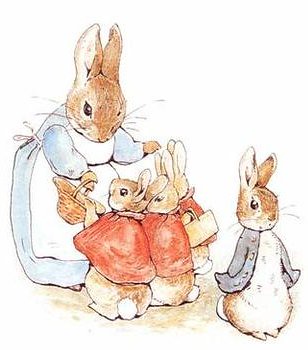
This is a story retold from the original story by Beatrix Potter. It is a story about some rabbits mainly Peter. It starts out that Mrs. Rabbit sends her three children out on a trip to pick blackberries. Her three children are named Flopsy, Mops
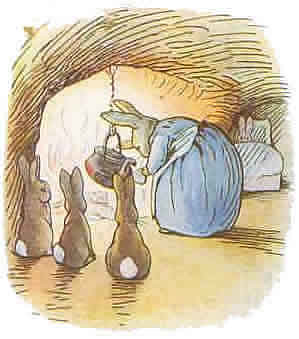
y, Cotton-tail, and Peter. They are sent out to pick blackberries and instructed to not disturb Mr. McGregor's garden along the way. This is a simple instruction to give her children considering it was potential dangerous to enter his garden. Out of the bunch it is one who is naughty and went into the garden. While in the garden he began to feast on lettuce, beans, and radishes but got a tummy ache so he ate some parsley. Mr. McGregor caught him in the garden who began to chase him and yell at Peter for being in his garden. Peter frightened ran around forgetting his way out and lost his shoes and jacket. He tries to hide in the toolshed but his sneeze gave him away and the chase began again. He finally jumped out of the window only to see his jacket and shoes as a scare tactic or scarecrow. His fear made him run as fast as can be until he made it home safe. His mother put him to sleep wondering what happened to him and where was his clothes and shoes. All he had was some camomile tea while his siblings ate blackberries and milk for dinner.

 Classroom Instruction:
Discuss the importance of obedience through games and color activities. Have the class to discuss a time when they were disobedient and what happened to them. Explain the lesson the learned through that experience.
Sample Questions:
1. We would discuss the importance of obedience by asking what did Peter do wrong?
2. We would discuss if Mr. McGregor was wrong for chasing Peter in his garden? ,
3. What are some things that Peter could have done differently to avoid getting chased?
4. Is it okay to bother or take someone else things? Why or why not?
5. Have you ever been in this situation before? How did it make you feel?
6. Why is it important to obey your parents, older people, and teachers?
7. Why is it important to follow instructions given to you?
http://www.peterrabbit.com/en/fun_and_games/colouring_activities
http://www.first-school.ws/activities/onlinestory/animals/peterrabbit.htm
http://www.wiredforbooks.org/kids.htm
Biography of Beatrix Potter
http://www.bpotter.com/Biography.aspx
Potter, Beatrix. 1988. The Tale of Peter Rabbit. China. Moonshadow Publishing, Inc.
www.gutenberg.org/ebooks/14838
http://farm4.static.flickr.com/3551/3456862787_5df8b04a29.jpg?v=0
Cinderella (First Readers)
 This is the story retold for new readers and it is very colorful. The beginning of this book is devoted to helping your child to read and the importance of reading. It discusses how to share reading, build confidence, and reading alone, tools needed to build a healthy reading relationship with you and for the child. The words are simple, big, bold, and easy to follow for any age child. This book draws your attention and promotes a healthy attention span in my opinion. It retells the original story of Cinderella at a level for children to understand and love. Cinderella is overlooked by her step-mother and bullied by her step-sisters by doing all the housework. One day a Prince comes along and invites all the girls in the land to the ball. The step-sisters did not want her to go and Cinderella did not have any nice clothes to wear. This made her sad and she then had to help her step-sisters get ready for the ball. She did all she could to make them look pretty and they went to the ball leaving her home alone. While she was sad her fairy godmother showed up to tell her she will go to the ball. She was given a list of things to get to bring to her fairy godmother: a pumpkin, six mice, two rats, and a frog, okay. These things she would use so that Cinderella could go to the ball and at the wave of her magic wand she had everything she needed. Only thing missing was a beautiful dress for Cinderella to wear. She went to the ball, met and danced with the Prince, and had to hurry home by midnight. She lost her shoe in the process and everything turned back to the way they were before. The Prince looked everywhere until he found Cinderella (the only one who could wear the lost shoe) and he married her. They lived happily ever after. In the back of this book it have a Read and Say section to teach children words by utilizing the pictures and to find the words in the story. It is a great teaching aide for younger children.
Classroom Instruction:
We will discuss the importance of treating people kind and fair. We will learn to point out new words that we learn within the story. We will discuss that true beauty comes from within the person.
Questions:
1. Is it ever right to mistreat someone or be mean to them?
2. Would you want someone to treat you this way?
3. How will it make someone feel if you treat them mean or bad?
4. What should you do if someone is being mean or treating you bad?
Resources for activities or games:
http://www.pinterest.com/snowteacher/cinderella-unit/
http://princess.disney.com/dress-up?group=cinderella
Reference:
Goldsack, Gaby. 2004. Cinderella First Readers. Bath BA1 1HE, Parragon Publishing.